EN
EN

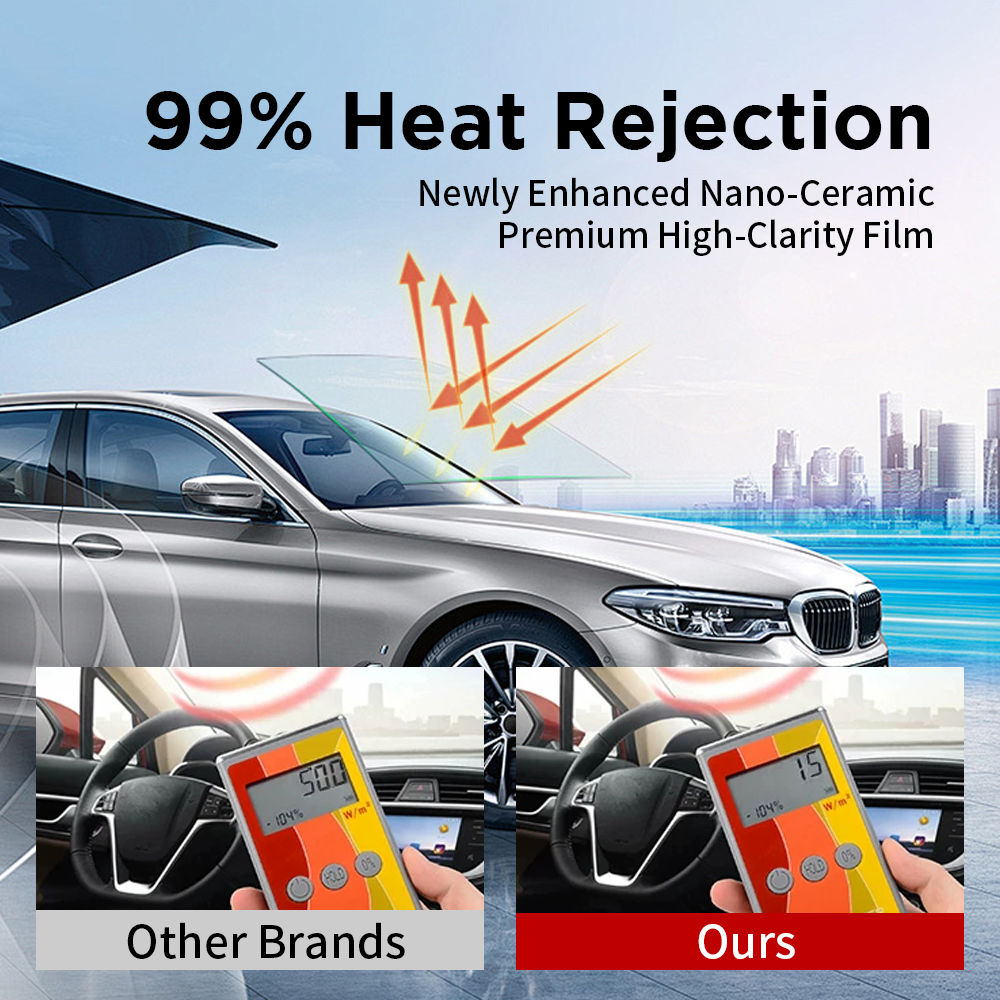
The Role of Full Solar Spectrum Rejection
Infrared rejection alone can be a misleading metric when evaluating heat insulation. Solar energy reaches the earth in three primary bands:
-
Infrared Radiation (IR): ~53% of solar energy
-
Visible Light (VLT): ~44% of solar energy
-
Ultraviolet Light (UV): ~3% of solar energy
A film that blocks near-infrared light effectively may still transmit significant visible light, which converts directly into heat once inside an enclosure. Evaluating true heat insulation requires looking at Total Solar Energy Rejected (TSER) rather than isolated IR numbers.
Nano-ceramic films are engineered to balance high infrared absorption with controlled visible light transmission, ensuring the interior stays noticeably cooler. As photothermal scientist Dr. Samuel Park notes in the Journal of Applied Polymer Science:
“The human sensation of heat behind glass correlates more strongly with TSER than with any single spectral band rejection.”
Ultimately, a film's ability to reject the full solar spectrum—rather than a single cherry-picked wavelength—is a primary factor in its thermal performance.
Why Total Solar Energy Rejected (TSER) Matters Most
How TSER values are measured and communicated significantly impacts real-world insulation:
-
Narrow Wavelength Quotes: Low-cost films often advertise IR rejection across a narrow band (e.g., 900–1000 nm) while ignoring the remaining infrared spectrum that carries substantial energy.
-
Full-Spectrum Performance: Standard TSER metrics (defined by NFRC and ISO 9050 standards) integrate the entire solar spectrum weighted by actual solar irradiance.
A spectrophotometric curve reveals whether a film transmits heat at longer wavelengths during peak heat hours. High-performance ceramic series maintain deep, flat rejection across the entire 780-to-2500-nanometer range. Architectural physicist Dr. Elena Rossi stresses that “without understanding spectral selectivity, you may overpay for a film that only performs on paper.”
The Impact of Glass Type and Installation Quality
Even advanced solar films underperform if the underlying substrate and installation process are neglected:
-
Substrate Compatibility: Clear float, tinted, low-E, and laminated glass dissipate solar absorption differently. Applying high-absorption films to single-pane annealed glass in extreme heat can induce thermal stress cracks due to uneven heat dissipation.
-
Installation Precision: Trapped moisture, dust specks, and edge gaps create micro-convection paths that allow heat to bleed through. Improper installation can reduce manufactured film efficiency by 20% or more.
Expert installer Marco Gutierrez emphasizes, “The last millimeter of film-to-glass contact determines the real insulating value.” Seamless integration between the film and glass substrate is essential for maximum thermal resistance.
Emissivity and Material Construction
Low-emissivity (low-E) properties measure how much heat a surface radiates back into a room, directly impacting year-round insulation:
-
Low-Emissivity Benefits: Films with metallic or nano-ceramic layers reflect interior heat back inside during winter, maintaining stable year-round temperatures.
-
Signal Transparency: While traditional metallic films can interfere with mobile and GPS signals, advanced non-conductive ceramic films achieve low emissivity without signal disruption.
-
Layer Construction: Base film thickness, adhesive clarity, and hard-coat quality prevent micro-wrinkling, ensuring intimate contact with the glass and maintaining a low U-factor.
Durability testing—such as 2,000 hours of QUV accelerated aging—verifies that emissivity values and polymer stability remain consistent over a decade of continuous UV exposure.
Real-World Synergy: A Fleet Application Example
A practical demonstration of these factors occurred during a fleet retrofitting project in Dubai, where delivery van cabins faced extreme midday heat under strict local transparency regulations (minimum 50% VLT on front windows):
-
Solution: Applied a 70% VLT nano-ceramic film delivering 58% TSER, broad IR rejection up to 2500 nm, and a low-emissivity layer to counteract radiative dashboard heat.
-
Results: * Average cabin temperature dropped by 12°F (6.7°C).
-
Air conditioning fuel consumption decreased by 8%.
-
Driver heat-fatigue complaints fell by 40%.
-
Maximum heat insulation is never the result of a single specification metric; it is the synergy of spectral selectivity, TSER, glass compatibility, material emissivity, and precise installation.